

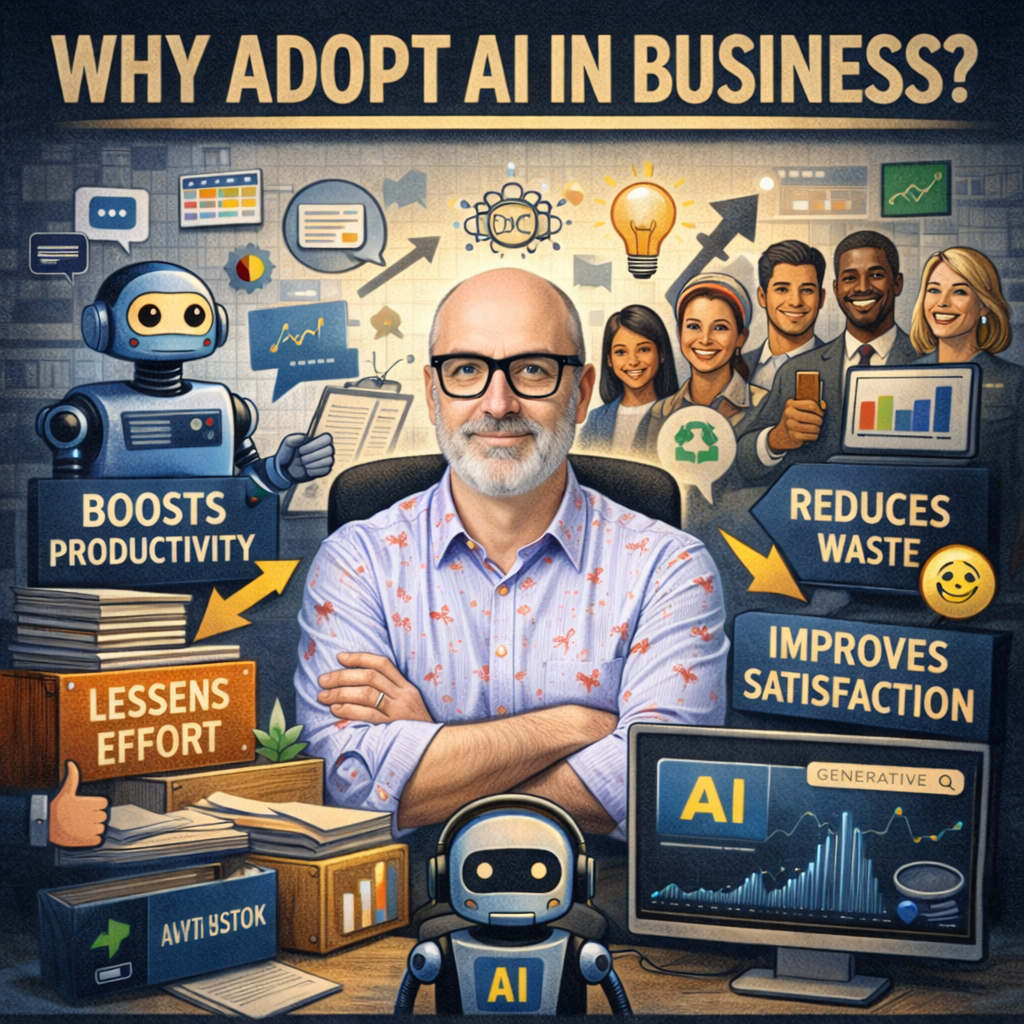
Artificial intelligence (AI) is no longer a futuristic concept reserved for laboratories and large technology firms. In 2026, it has become a practical, measurable tool that drives operational efficiency, reduces repetitive work, boosts employee satisfaction and materially increases productivity across industries. The evidence from academic research, industry studies and real world deployments shows that organisations embracing AI today are positioning themselves for competitive advantage, while those that hesitate risk falling behind.
AI Improves Productivity and Efficiency
A range of controlled studies shows that AI tools substantially increase task throughput compared
with traditional methods. For example, across several real world task settings:
Support agents using generative AI tools could handle more inquiries per hour, professionals generated significantly more business documents, and programmers completed more projects weekly compared with counterparts without AI assistance. Such use of generative AI delivered an average 66% productivity improvement.
Source: Nielsen Norman Group, AI Improves Employee Productivity by 66% –
https://www.nngroup.com/articles/ai-tools-productivity-gains/
McKinsey & Company’s research also emphasises how AI automates routine tasks, allowing
employees to focus on higher order work such as problem solving and decision making.
In another large employer context, real world field experiments in online retail showed that AI use
(such as personalising product engagement) led to measurable productivity and revenue gains
when compared with traditional workflows.
Source: arXiv – Generative AI and Firm Productivity – https://arxiv.org/abs/2510.12049
AI Reduces Repetitive Administrative Work
One of the clearest operational benefits of AI is its ability to handle repetitive, low value
administrative tasks, data entry, scheduling, basic summarisation and routine reporting which
absorb significant staff time. By automating these tasks:
- Organisations can free up employees to engage in strategic, creative or high judgement work rather than repetitive admin.
- Errors associated with manual work are reduced.
- Process turnaround times improve.
Industry guidance emphasises that automation improves overall business productivity by reducing
the time spent on non value-adding work.
AI Enhances Job Satisfaction
Contrary to early fears that AI would displace human workers wholesale, research suggests that
when implemented thoughtfully, AI can improve job satisfaction, engagement and career growth:
- AI reduces the burden of mundane tasks, allowing employees to focus on more meaningful work a strong predictor of job satisfaction and well-being.
- Organisations report that automating stressful tasks such as scheduling and meeting coordination helps reduce burnout and improves employee experience.
- Surveys of workers indicate that adopting AI skills correlates with career advancement opportunities, with those embracing AI tools more likely to be viewed as high value employees.
Source: Business Insider, Cisco study on AI and career advancement –
https://www.businessinsider.com/want-a-promotion-it-might-pay-to-use-ai-2026-1
Four Practical Examples of AI Use in Business
Below are real world, practical applications of AI that any business can implement today:
- Automated Customer Service Drafting and Response AI assistants can draft and suggest replies to customer emails or chat queries, reducing turnaround time and improving consistency.
- Intelligent Scheduling and Workflow Management Digital assistants automate meeting schedules, assign tasks based on workload and generate follow up reminders.
- Data Driven Reporting & Insights AI can summarise raw data into executive ready reports, highlight anomalies and visualise trends — saving hours of manual analysis.
- HR Process Automation AI supports drafting job descriptions, sorting applicant CVs, and personalising employee learning pathways — freeing HR professionals to focus on strategic people work.
These use cases go beyond hype, they are increasingly becoming core components of how businesses operate.
Conclusion: AI Is Not a Technology to Ignore
We are at a decisive moment where AI is reshaping how work is done across sectors. Organisations that adopt AI in a controlled, ethical and strategic way can boost productivity, improve employee satisfaction, reduce wasteful admin and strengthen decision quality. The case for AI is not abstract it is measurable.
If your business is still waiting on the sidelines, the cost of inaction will rise as competitors adopt AI to improve efficiency and talent retention.
To begin your AI transformation with clarity and confidence, speak with Clarai, a specialist partner in practical AI integration for businesses seeking rapid productivity gains and better internal processes. Clarai can help assess your current workflows, identify high impact opportunities for AI, and set a roadmap that aligns with your strategic goals. Engage Clarai today and ensure your business is leveraging AI not only to compete but to lead.