

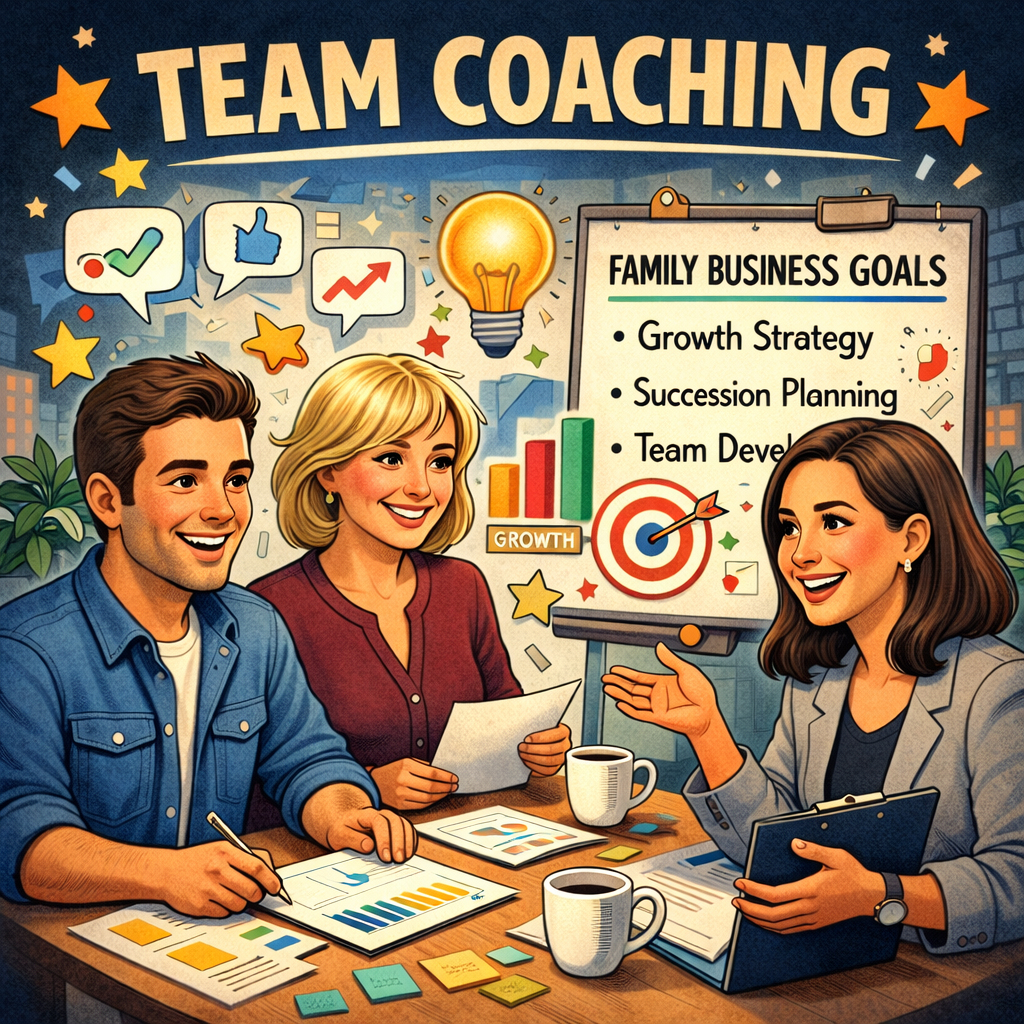
Why It Drives Growth, Strengthens Relationships, and Prevents Conflict
Family businesses are the backbone of the UK economy. Built on trust, shared history, and hard-won experience, they often outperform corporates on loyalty and long-term vision. Yet those same
strengths can quietly become constraints if leadership, communication, and roles are left
unchecked.
Leadership and team coaching is increasingly recognised as one of the most effective ways for
family businesses to scale sustainably, professionalise decision making, and avoid the internal
conflicts that derail so many otherwise successful businesses.
This is not about replacing tradition. It is about protecting it.
The Hidden Challenge of Family Dynamics
In a family business, conversations are rarely just about business.
A disagreement about strategy can quickly become a replay of sibling rivalry. A performance issue
may be avoided altogether because “that’s just how Uncle John is”. Authority is often assumed
rather than defined, and accountability can feel personal rather than professional.
Research consistently shows that family conflict is one of the leading causes of stagnation and
failure in multi-generational businesses:
Only 30% of family businesses survive into the second generation, and fewer than 12% into the third
(Source: Institute for Family Business)
https://www.ifb.org.uk/resources/family-business-statistics/
Leadership and team coaching directly addresses this by separating roles from relationships and
creating a neutral, structured environment for honest discussion.
What Leadership Coaching Really Delivers
Effective leadership coaching in a family business does three critical things:
1. It Professionalises Leadership Without Losing Identity
Coaching helps founders and senior family members shift from doing to leading. This is particularly
important where the business has outgrown the original operating model.
A Harvard Business Review study found that organisations with strong leadership development are
2.4 times more likely to hit performance targets.
https://hbr.org/2019/10/why-leadership-training-fails-and-what-to-do-about-it
For family firms, this means:
- Clear decision making authority
- Defined leadership behaviours
- Reduced reliance on personality and legacy alone
The business becomes scalable without becoming corporate.
It Creates Safe Space for Difficult Conversations
Family businesses are often polite on the surface and tense underneath.
Team coaching introduces structure:
- Clear meeting disciplines
- Agreed ways of challenging decisions
- Rules of engagement that protect relationships
According to the International Coaching Federation (ICF), 86% of companies report a positive
return on investment from coaching, with improved communication cited as the top benefit.
https://coachingfederation.org/research/global-coaching-study
When people feel heard, conflict reduces. When conflict reduces, focus returns to growth.
It Aligns the Family Around a Shared Future
One of the most common failure points in family firms is misalignment between generations.
Founders often value control and stability. The next generation values innovation and pace.
Coaching bridges this gap by turning competing perspectives into complementary strengths.
A PwC Family Business Survey found that only 34% of family businesses have a documented
succession plan, despite succession being the single biggest risk to continuity.
https://www.pwc.co.uk/services/private-business/family-business.html
Coaching supports:
- Succession planning without emotional fallout
- Clarity on ownership vs leadership roles
- Shared purpose beyond individual agendas
Why Team Coaching Accelerates Growth
Growth stalls when teams second-guess decisions, avoid accountability, or wait for permission.
Team coaching builds:
- Collective ownership of outcomes
- Faster, better-quality decisions
- Trust across family and non-family leaders
The CIPD reports that organisations with high trust and strong leadership capability are more than
twice as likely to outperform their competitors financially.
https://www.cipd.org/uk/knowledge/reports/people-performance/
In family businesses, this often unlocks the next phase of growth without burning out the people
who built the company.
A Quiet Advantage in a Noisy Market
Well run family businesses have a unique advantage: long term thinking.
Leadership and team coaching ensures that long term vision is not undermined by short term
emotion. It protects relationships, strengthens governance, and creates a culture where both family
and non family leaders can thrive.
The result is not just a better business.
It is a business that lasts.
Final Thought
Family businesses do not fail because they care too much.
They fail when care replaces clarity.
Leadership and team coaching restores that balance honouring the past while building a future that is robust, professional, and aligned